Rock and Roll: Where are the women? SINEAD O'CONNOR


Okay, O'Connor is not my fav-- but Paul makes a great case for her: 

Yes, Sinéad O'Connor is angry. One might think her anger would increase her chances for being inducted into the Rock Hall, but the HoF Foundation seems much more comfortable with angry young men than angry women of any age. O'Connor is also crazy, but craziness, as Adrienne Rich explained, is a natural response when we are lied to by the people we trust. What critics sometimes ignore is that O'Connor is as earnest as she is talented. She continues to search for sanity, peace, meaning. And her search has produced beautiful music in varied genres for three decades. I still get chills when I listen to "The Lion and the Cobra" and "Throw Down Your Arms." On dark days I still listen to "Faith and Courage." Sinéad O'Connor's music never gets old: 

(click to hear)


Rock and Roll Hall of Fame: Where are the women? BUFFY SAINTE-MARIE


Guest blogger Paul Beauvais in his continuing series on women who belong in the Rock Hall of Fame:

I understand why the Rock Hall ignores Buffy Sainte-Marie. No doubt they consider her too "folkie." Hell, she recorded for Vanguard, so there's no way that she can be a rocker, can she? Ignore that the title track of her first album, "It's My Way," is a song that I can easily imagine Bruce Springsteen or Eric Burdon covering. Ignore that "Cod'ine," another song on the album, was covered by Joplin, Quicksilver Messenger Service, and Courtney Love. And, of course, Donovan covered "Universal Soldier," a great song, but back then he was still a folkie, too. And, if being a folkie wasn't bad enough, Sainte-Marie also penned "pop" songs: "Until It's Time for You to Go" and "Up Where We Belong" (for which she won an Academy Award). So of course she doesn't belong in the Rock Hall. But guess what? The older she gets, the fiercer her music becomes. She's put together a band that can rock her old catalog, and her new stuff sounds powerful and fresh. 


Rock & Roll Hall of Fame: Where are the women? CYNDI LAUPER

This is part 1 of a 7 part series by Guest Writer Paul Beauvais on a few of the women who should be in the Rock and Roll Hall of Fame.


Why isn't Cyndi Lauper in the Rock Hall? My best guess is that her versatility is held against her: she can sing superbly in many genres, so it's easy to ignore her rock and roll
Lauper was in the HOF "Women Who Rock" exhibit.
Isn't it time for her to be in the Hall permanently?
pedigree. Her earliest work was in cover bands playing Joplin, Airplane, and Zep, and her first demo tape led to a contract with The Allman Brothers' manager. But I hear an even earlier rock influence in her work: Ronnie Spector and the girl groups of the early sixties. That was music that never meant much to me, but Lauper managed to warp it into something fine, something funny, something feminist. The Rock Hall pretty much made her the poster child for their "Women Who Rock" exhibit, but they seem to be drawing the line at actually making her a member of the club. Let's hope that changes soon.
While Yoko Ono looks on, Lauper sings
 One more--I never get tired of watching this one--Cyndi sings Joni Mitchell's "Carey"

Guest Blogger Paul Beauvais - Intro: Rock & Roll Hall of Fame, where are the women?

On October 15th, the Rock and Roll Hall of Fame published this year's nominations,
and Paul Beauvais posted on Facebook: 

"Rock Hall nominations. Let the kvetching begin. My first reaction: sixteen nominees, three women?

"A short list of women the Rock Hall continues to ignore: Bikini Kill, Tracy Chapman, Cher, Merry Clayton, Melissa Etheridge, Marianne Faithfull, Roberta Flack,The Go-Go's, Cyndi Lauper, Miriam Makeba, Holly Near, Nico, Suzi Quatro. My friends can name more."

Over the next two weeks, Paul wrote several posts on why he thought some specific women in particular deserve to be in the Rock Hall. He also articulated why he thought the issue was worth discussing: 

"I've posted quite a bit about the Rock Hall in the past week, and I imagine that some of my friends are wondering, "Why bother?" It's a fair question. The very idea of a Rock HoF seemed suspect to me when I first heard about it. But experiencing the Hall in person has led me to appreciate having it nearby. I've heard good music performed there. I've attended informative lectures. I've enjoyed some of the special exhibitions (particularly the "Women Who Rock" and "Summer of Love" displays and the John Lennon memorabilia). I've seen the Hall evolve (for better and worse), at times trying to curate an experience that provides a coherent narrative of rock history and at other times settling for being incoherent but in a fun way. As rock itself diminishes in cultural significance, the Hall will, too. But I hope that it still finds a way to be an important part of Cleveland's cultural scene."


In order to give Paul's posts a larger audience, I asked if I could collect them here, and he gave permission, so I will be posting one of these a day for the next week. 

Already the Melissa Etheridge fans have "liked" his defense for Etheridge, and we can hope that other fans will speak up and out for the seven women artists he has discussed and others he has named. Maybe even the Rock Hall committee will listen. For next year.  

LOVING LANGUAGE and LINGUISTICS

I just love linguists, how they listen and count and interview and try to make sense of language, which is filled with sense but also with nonsense and no sense whatsoever. (One of my favorite linguists is quick to point out that his middle name is Jude, patron saint of lost causes.) I should qualify that I love descriptive linguists, the ones who are just trying to figure out what the heck is going on and not prescriptive linguists, especially  the ones on Facebook, the Mrs. Grundys intent on catching our every subject verb agreement. Not that I don't like to have perfect subject-verb agreement and to slip in the subjunctive at the appropriate moment, well, sometimes I get busy lol-ing and I mess up.

Right now, I am in love with Gretchen McCulloch and her book, Because Internet: Understanding the New Rules of Language. Because her subtitle notwithstanding, McCulloch is not so much setting down rules in the usual sense, but trying to make sense of emails and tweets and Facebook posts.  By
the first chapter, I had learned a new word, keymash, which she defines as "that haphazard mashing of fingers against the keyboard to signal a feeling so intense that you can't possibly type real words....[and] might look something like 'asdljklgafdljk.'" And then, McCullouch goes on to give five "patterns" that keymash tends to have beginning with they usually begin with "a." Wow, a paragraph ago, I didn't know what a keymash was, and now, I know some of its "rules," which as in all things language, are all preceded by "almost always" or "usually." Like i before  e except [insert 3 million extra rules and exceptions here.) See, I like that about language. Exceptions. Almosts. Usuallys. Don't count on it, buster.

Anyhow, that was chapter one, "Informal Writing." Chapter two "Language and Society," begins with one of my favorite topics, "Dialects." (Check it out: fun history of its beginnings in the 18th century Germany and France.) The author asks, "Does it ever feel like your family...speaks its very own dialect?" Why, yes, yes it does. And decades ago, I wrote about it for a WVIZ show called, "Signature," which featured brief personal essays read by local authors. I myself read several on air, but the show was cancelled before I ever got to spout this one. And though my parents are dead and my siblings barely speak to me, these words remain true, even though I haven't read Garp since 1979, even now in the age of the Internet, although not Because Internet:

Kendigese was our dialect of Familish, a variation of English understood only within a particular family. In the movie Garp, the terms "undertoad" and "gradual student" distinguish  the Garpese dialect of Familish. 

Kendigese was particularly helpful at the table. If asked to pass a roll and not "the creepled kaind" pass a cloverleaf, a plump one, not a mangled one. This expression originated with my mother's childhood neighbor, Mrs. Kostoff, a Bulgarian, who coined another of our phrases, "three handkerchiefuls." In a sentence like, "This TCM movies is a three handkerchiefuls," it means that the movie jerked a lot of tears out of you. And don't be telling me about the proper "handerchiefsful." This is our dialect's rules now.

If you were asked to pass something that was "kittyunkwise," from  you, that would be on a diagonal more acute than if you were told it was "cattycornered," the usual word for a diagonal. 

Or my father might laughingly shout, "Howlda moulda fresch dein zoup," which he told us his father shouted at the table when his brood of 13 got going, and it meant, "Hush up and eat your soup." My grandfather was Pennsylvania Dutch, and when my sister took German, she learned how very far that phrase is from hushing and soup. And since we shouted it as likely during dessert as soup, it really was a non sequitur.

As an aside, my mother could have been the keynote speaker  at a non sequitur convention. She would spout baffling aphorisms like "time is time" and "money is money" at untimely and uneconomical places in the conversation. 

McCulloch notes that many family dialects are inspired by the children, as with my friend Kate's family expression, "se la vache," French for "such is the cow,"
 which was one of the children's renderings of her father's response, "se la vie," when the children were whining in self-pity."


Kendigese's unsympathetic response to children's perpetual question, "Why?" (pronounced whyyyyyeeee? Close, now do it while you whine) was"Why don't toads have wings?" which short for "If toads have wings, they wouldn't bump their butt when they jump, but they do bump their butt because they don't have wings is why.")

There are other Kendigeses. Heresickness is one. "Homesickness" means to miss home, what happens to you when you come from a home you love, and it can happen in the best of places, even staying overnight at Grandma's, but "heresickness" well that is being in a miserable place. A "thing" is just a thing, but a "dingus" is at thing which my father told us (in adulthood, over the phone) to lift, turn, or relight, and when we did, whatever was not working, would suddenly work. A "good time" is a good time, but a "laughy time" in a fun time, and that comes out of my memory for the first time I ever remember coining a word, when I was 3 or 4 years old.

I don't have time right now to provide an unabridged dictionary of Kendigese, because as Mom used to say, time is time. (And all you old Clevelanders remember what Capt. Penny said about what Mom said.) Besides my goal here is not to teach my dialect but to talk you into listening to your own and your friends' and your in-laws'. If you are confronted by what you think is someone's Familish, ask for the meaning and etymology. Speakers of Familish are bilingual, and their translation might be quite laughy. 

It will not surprise parents of teens to learn that McCulloch notes that high school is the place where kids really note small social details, like who is going out with whom and who is wearing what and --get this-- vowels. Check out her paragraph on Detroit high school students' vowels.

Meanwhile, I have to finish chapter two. I can hardly wait for chapter five, 
emojis!
 

Oops!  I meant -------------->

HOME AGAIN and AGAIN

I started this blog in fall of 2011, just as I was coming "Home Again," to the home I was born and raised in, after nearly 40 years of living elsewhere. I came, with the help of my husband, Paul Beauvais, to buy my father's house so Dad could come home to it once or twice a week from Assisted Living. The move didn't help our retirement funds, but it sure created wonderful moments for the last eight years of Dad's life. When he died, just days after his 94th birthday this past March, I felt saddened of course, but deeply at peace for what we had accomplished. Together, we three had really learned to "number our days." I learned about Dad, about us, about dementia, and about aging in America, and I am grateful for those days. 

In the following months, there was a memorial service to plan and execute with a bagpiper and military funeral honors (which Dad had asked for) by two soldiers from Wright Patterson AFB and
Sippo Lake in autumn
a 21 gun salute by our local VFW. Although we held off till the end of April, the small crowd of us at the cemetery had to stand under a small white tent as freezing rain fell, fairly miserable conditions. I know Dad would have said what he always said when you were stuck with a bad situation: "What are you gonna do?" (Go on.) We had the military honors, the 23rd Psalm, the bagpipe, "Amazing Grace." Several people said afterward it was the most moving memorial they had been through. Go figure. 


Afterwards, we went to Sippo Lake, where
Dad had put in so much recreational time, skating and hiking with us as children, and so much volunteer time with the neighbors. At the Marina clubhouse, we had the "bereavement dinner," of Dad's dreams including many many pies home-baked by friends and family. A lunch catered by a high school friend's business. Many people got up and spoke informally and warmly about Dad.


And then, as I've written in a poem recently: "I myself ask what I’ve done with the hours/I used to spend with you, weekly doctor visits/ before stopping for pie, the real event..." Summer seemed to go by so very fast, but then, it always does, like weekends. 

As a teacher for over 40 years, the new year always seems to begin in fall for me. So I am back planning two writing activities in Cleveland, preparing to be a poet in the schools-- heading off to see about first graders at Sandy Valley this week. I am back to sending poems out, being rejected at an amazing rate, and for the first time in ages, I am sending out my family musical, Talk to the Moon, getting requests for synopsis and scripts. (Anyone need a play to produce? Message me!)

This weekend, Paul and I went house hunting in Cleveland for the third time in our lives. We didn't find the house of our dreams yet. We never have because we don't have a dream house. We've made a home of wherever we have lighted-- which has been a lot of places. The term "real" estate just seems very humorous to me. (I've been laughing about real estate terms with my friend Peter who has been waiting nine months just to hear back on his bid to buy a place that is a "short sale." Hahahaha.) We plan to try again. Cleveland has more art museum and orchestra, more poetry readings and poets and writers. (And for Paul, the Beachland Ballroom, for starters.) Here we have woods and lake a short walk away, a well-built house small enough to care for, lower taxes and easy driving...except for all the driving to Cleveland. So we'll see where we are come winter.

Meanwhile, our front porch these days is beginning to look like the photo above that I took five years ago: the impatiens are played out, the mums are up, the pumpkins out. I see my reflection in the door, taking a picture of me taking a picture of my home....again.  

 But though I have learned to number my days, I hadn't gotten back to the blog till today. And if you thought I was getting ready to say that I am letting go of the blog, then, I I have to say, I am not. I am back, still "Home Again," wherever that is, trying to share here a few informal words in prose a few times a month about poems and homes. Again. 

 Teach us how to number our days


CUTTING UP WITH CANTON KIDS

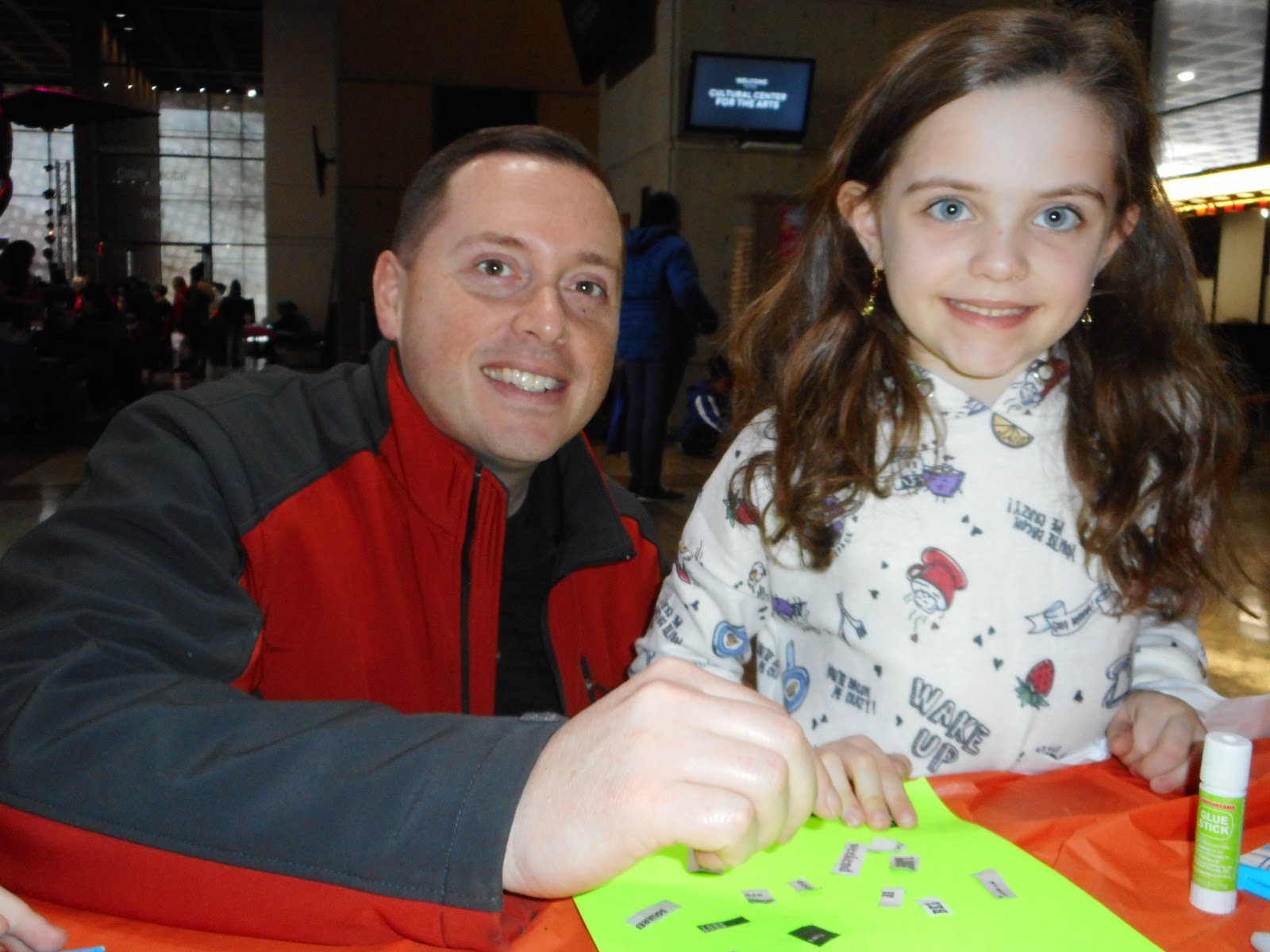
I've signed on to do some Visiting Writer gigs for Stark County's Smart Arts (SmARTS), and today, I womaned a table at the annual arts festival for kids at the Canton Cultural Center-- a free day of art making and performing.

My table was about making the "Cut-Up" poem. The idea is that words are cut out of a text-- in my case today, the The New York Times monthly Kids Section--and put into a container (I used envelopes). Each poet pulls the words out and makes a poem of them. Glue sticks keep them in place, and markers provide extra words and illustrations. Many thanks for Harter School teacher Tina Riley, who assisted.

Aside for adults: The form was inspired by the 1920's Dadaists and especially, Tristan Tzara. (He's a hysterically funny character in Tom Stoppard's Travesties. He put the words into his hat, forgets, puts the hat on and sends words fluttering all over. He's in love with a librarian whom, he fears, "thinks of me as nothing but a belle litterer.")


Below are some of the kids and parents who came by and cut up with me. (I have to say, the parents are the real cut-ups.) This was pitched for fifth graders, but many 1st through 4th grade kids did great, too, and the kindergartners just ran bright markers over the page happily. One of the things I love about this project is that it's writing as messiness. So many kids are afraid to "goof up" on paper. These poems aren't about neatness but wildness. It was a good day. If you are interested in trying an online version of this, here is a tool you can use:

http://www.languageisavirus.com/cutupmachine.php#.XHswNi17nyE

And here is another:
https://stickbucket.com/cut-up-technique-generator/

And here are the kids at work and their works:


Playground is fun for familys because it good./The thing that makes you dizzy is a tire swing. - 1st grader and Dad ---->


Butterfly discover dreams/appreciate a good story/fly high/ Are you going to try it?

The hat is different parts inside


Kids interested in sledding & cats. 💖

Happy dogs make best friends

You Smile BIG! 
3 Sisters, 3 Poems

The community has an opinion about everything

Speak what you feel because the world is awesome.

Dad LOVED this word selection: panthers, habitat, etc.

An acrostic for her sister Ava, a swimmer
So you have cheese tomorrow? I said, no cheese..- 1st grade